
You will be the best parents in the world, Dad and Mom
This post was not planned. It was supposed to be a section of the previous one, a passage among others, wedged between the surgical report and the announcement of the next post. And then it grew. It took up space, breath, strength. And I understood that it deserved to exist on its own, because what it tells cannot be a paragraph in a post about surgery. What it tells is the foundation on which everything else rests.
On the other side of the wall
There is a perspective on the day of the operation that is not mine. It is my parents'.
While I was sleeping, while the surgical team was working, while the hours were passing, they were waiting. And the wait, when it is your child who is on the table, when it is his brain being operated on, when you cannot do anything other than watch time pass and hope the phone does not ring for the wrong reason, is probably the hardest day they have ever lived.
I will never know exactly what they felt during those hours, because it is not the kind of thing you can put into words, even after the fact. The stress, the helplessness, the dull fear that will not let go. Having brought a child into the world, having watched him grow up with a disease, having walked alongside him through every battle told in the previous posts, and watching him enter an operating room for brain surgery without being able to do anything other than wait.
But there is one thing that makes me smile when I think back on it. Even in the haze, barely awake, my brain still fogged by the anesthesia, unable to string two coherent thoughts together, I knew my mother's phone number by heart. There are things that even brain surgery cannot erase.
What I need to say
And since this series of posts is about trust, I need to say this, and I need to say it well. I need to say it loudly, even.
Everything I have told in these posts, from nursery school to that operating table, I did not do alone. My parents were there. Not "there" like background scenery, not "there" like some vague and distant support. There. At every medical appointment, at every battle with an institution, at every moment of discouragement, at every closed door that needed to be broken down. They fought for me when I was not yet old enough to fight for myself, and they kept fighting when I was old enough to do it alongside them.
They absorbed the stares, the remarks, the misunderstandings, the indifference of the system, the brutality of certain professionals, and they never gave up. Never. Not once. When the whole world seemed determined to make things harder, they were there to make them possible. When secondary school destroyed me, they were the ones who rebuilt me. When I was told that preparatory school was too complicated, they were the ones who told me to go for it. When I was afraid of this operation, they were the ones who were even more afraid than I was, and who still let me jump.
The emails
Before the operation, I had found a way to give them "news" while I would be in surgery: delayed emails, pre-recorded, scheduled to be sent at regular intervals. Small messages prepared in advance so that they would not spend hours in total silence. So that there would be something in their inbox, even if that something came from a son who was asleep with his skull open hundreds of meters away. It was my way of telling them "I am here" even when I was not in any state to say it.
But nothing replaces being present. Nothing replaces having come, having waited, having endured the unendurable without being able to do anything other than hope. Nothing replaces being there when your son comes out of surgery, when he vomits, when he is in pain, when he is half dazed, and when he calls you because your phone number is the only thing the anesthesia did not manage to erase. They were there. As they have always been there. As they will always be there.
Thank you
So thank you. Thank you from the very depths of everything I am. Thank you for thirty-five years of silent battle, for the sleepless nights I do not know about, for the tears I did not see, for the worries you kept to yourselves so as not to add to mine. Thank you for holding on when it was hard to hold on, for believing in me when it was hard to believe, and for being there on the longest day of your lives, waiting in a hospital corridor for your son to come out of surgery with electrodes in his brain.
Thank you for making me someone capable of jumping. And thank you for being at the bottom to catch me if the cord had snapped.
Dad, Mom: without you, none of this exists. Not the preparatory school, not the degree, not the thesis, not this operation, not these posts. Nothing. Everything I am, everything I have built, everything I will still build, I owe to you first. And if one day my words help someone else, it is you who should be thanked before me.
"If," by Rudyard Kipling
Rudyard Kipling wrote a famous poem called "If." In it, he speaks of courage, perseverance, dignity in the face of adversity. It is a father speaking to his son to tell him what he will have to endure to become a man.
I would like to write the reverse poem. The one a son addresses to his parents.
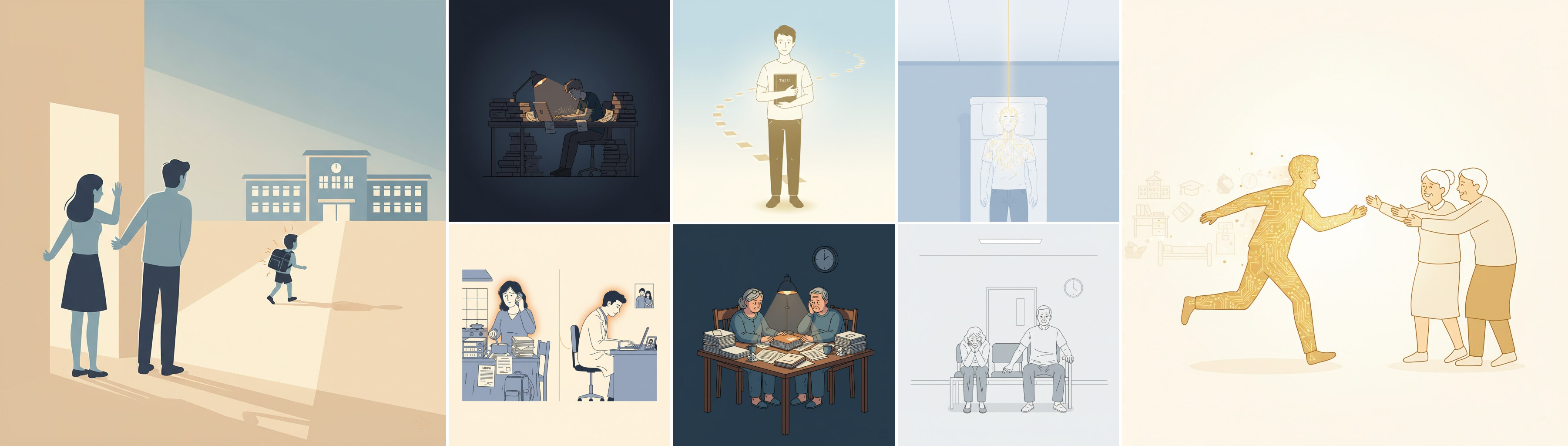
You will be the best parents in the world, Dad and Mom
If you can watch your child tremble from his very first steps and never look away.
If you can watch him learn to walk and know, before he even has the words to say it, that something is wrong.
If you can hear children say "you're shaking!" while pointing at him and swallow the pain so your son does not see it on your face.
If you can, when the whole world pretends not to see, refuse to pretend.
If you can absorb the diagnoses, the prognoses, the words that fall like sentences in white offices, and get up every morning to keep fighting.
If you can search for years for a name for what is wrong, consult, consult again, insist when specialists shrug their shoulders, and finally find three letters and two numbers that explain everything: DYT11.
If you can learn that it is genetic, and believe for years that it comes from you. If you can live with that guilt, the guilt of having perhaps passed on to your child the thing that makes him tremble, that makes him suffer, that makes his life ten times harder. If you can agree to be tested, to wait for the results knowing that the answer might confirm what you dread the most. And if you can, when the tests come back negative, when it turns out that no, it was not you, that the mutation appeared de novo, feel a relief mixed with the absurdity of it all, because your son trembles all the same, and knowing it is not your fault changes nothing about the pain.
If you can watch your son brush his teeth with both hands, spill water with every glass, struggle to go down a staircase, and not cry in front of him.
If you can watch your son invent his own workaround strategies, figure out on his own how to hold a glass, how to go down a staircase, how to live with a body that will not cooperate, and follow him in those solutions without ever imposing them on him, without ever deciding for him, being there when he needs you and stepping back when he needs to do it alone.
If you can face the institutions, the administrations, the MDPH files, the forms in triplicate, the stares, the silences, the closed doors, and break them down one by one without ever losing sight of the one you are doing it for.
If you can fight with a secondary school, a high school, a preparatory school, an engineering school... with an institution that calls itself educational to provide a computer to a child whose hand can no longer write, and start again the next day when the answer is no.
If you can accompany your child to school every morning knowing that what awaits him inside is sometimes worse than the disease itself. If you can stand tall when school destroys your child, when students mock him, when teachers add cruelty to indifference, and rebuild him brick by brick with your bare hands, every evening, at home, because no one else will do it.
If you can, when your son comes home from school in pieces, find the words to tell him that those who hurt him do not deserve him, and that his worth does not depend on what his muscles do or do not do.
If you can give him the will to fight without giving him hatred.
If you can, when high school arrives and the rebuilding begins, be there without smothering, support without overprotecting, encourage without pushing too hard.
If you can, when your son tells you he wants to do preparatory school, doubt in silence. If you can think it is too hard, too risky, that the world is not made for him, and not say it. If you can watch him convince you, argument after argument, with that stubbornness that is his, and end up letting him go despite your doubts. And start again when he announces engineering school. And start again when he announces the thesis. If you can, every time, swallow your fears and trust a son who knows more than you about what he is capable of enduring.
If you can be proud of every victory without ever minimizing what it cost.
If you can watch him leave alone, abroad, for an internship, your heart tight, knowing he needs to prove to the world and to himself that he can live alone, and let him do it.
If you can accept that your son defines himself first as an engineer, as a researcher, as a teacher, before defining himself as disabled, and understand that this pride is something you gave him.
If you can, when your son is an adult and a specialist calls him an idiot, or a healthcare worker treats him with the utmost condescension, contain your rage because it is no longer your fight but his, while being ready to step in if he asks.
If you can accept that he grows up, that he decides, that he chooses to have brain surgery, and be even more afraid than he is without ever showing it.
If you can listen to your son calmly explain that he has put all his affairs in order, just in case, and not break down.
If you can watch him leave for Paris with a surgery date in his pocket and a calm you do not understand, and not crack in front of him.
If you can drive him to the hospital, walk through the doors of Pitié-Salpêtrière with him, and let him go where you cannot follow.
If you can read his delayed emails while he sleeps with his skull open, those small messages scheduled in advance so that you would not be left in silence, and understand that even as he was heading into surgery, he was thinking of you first.
If you can wait for hours with no news, not knowing whether your son is alive, conscious, intact, in a corridor where time has stopped, and hold on, simply hold on, because it is all you have left to do.
If you can, when the surgeon finally comes out and says everything went well, feel your legs give way and not fall.
If you can hear his voice on the phone after the operation, broken, exhausted, nauseous, and recognize in that voice the baby you brought into the world and the man he has become.
If you can still accompany him in the months that follow, the adjustments, the dizziness, the nausea, the fog no one can explain, with the same patience you had when he was four years old.
If you can stop working, give up everything you have built, all the effort you put into your own career, and become your son's personal care assistant because no one else can do it. If you can accept that your daily life becomes his, that your days align with his needs, his appointments, his impossible gestures, his administrative files, his battles with institutions that do not understand. If you can be there every morning, every evening, every weekday while your husband works hundreds of kilometers away, and carry the weight of being present alone. If you can know by heart every movement that gets stuck, every situation that blocks, every day that weighs heavy, with that attention, that patience, that intimate knowledge that no one else will bring.
If you can make your entire life an extension of his, not out of sacrifice but out of the obvious, because a mother does not calculate what she gives.
If you can, when your medical expertise cannot cure him, put that expertise to work on what it can do: search, eliminate, propose an etiological workup when no one else thinks of it, because a father who is a doctor remains a father before being a doctor. If you can work endlessly and tirelessly, leave on Monday, come back on Friday, miss the weekday evenings, the homework, the crises, the small everyday victories, and accept that your role as a father plays out at a distance, by phone, on a delay, compressed into two days a week. If you can choose not to see your family every day so that your family can live, support without proximity, love without presence, hold everything together at arm's length from an office hundreds of kilometers away, and come back every weekend as if you had never left.
If you can make that sacrifice, year after year, without ever calling it a sacrifice, because for you it is simply what a father does.
Then you will be the best parents in the world, Dad and Mom.
But you already are.
Thank you.