
Easter Egg Mode
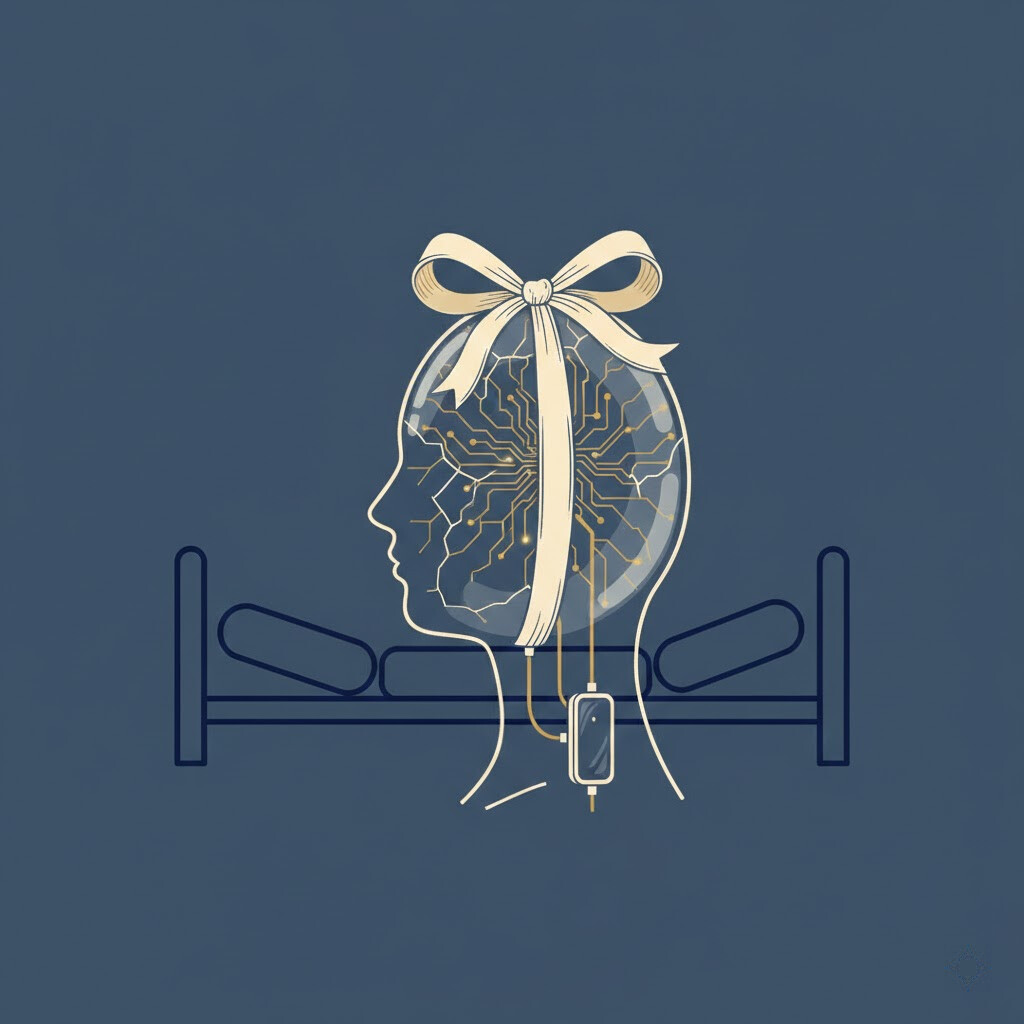
The previous post ended with the waking up, the vomiting, the four angels who weren't really angels, and the feeling of being more alive than ever. This one tells what comes next: the days of hospitalization, the body discovering what's been done to it, and learning to coexist with a medical device that can never be completely removed from your life.
The head
The first thing you notice when you wake up is your head. They told you, they explained it, you knew it would hurt, but there's a difference between knowing and feeling. Your skull is pressing. Not a sharp pain, not a throbbing — more of a constant, heavy pressure, as if your head had become an Easter egg that someone had squeezed a bit too tight in its wrapping. Everything is sensitive, everything is swollen, and simply resting your head on the pillow requires a negotiation with the angle, the pressure, the side.
You get used to it. You don't have a choice.
The chest — the real surprise
What nobody had really prepared me for was the chest. The device, the pulse generator, is implanted under the skin of the thorax, on the left side. And that's where it hurts the most. More than the skull, which is pretty paradoxical when you think about it. They drill through your skull, they plant electrodes in your brain, and it's the device in your chest that keeps you from sleeping on your side.
The pocket carved under the skin is tender, the scar pulls, and every movement of the left arm is a reminder that this thing is there, under the skin — hard, rectangular, permanently foreign and permanently in residence.
The cable
And then there's the cable. The cable that connects the electrodes to the device, running under the skin of the skull, down behind the ear, along the neck, and into the chest. You can't see it from the outside, but you can feel it. With every head movement, every rotation of the neck, there's this sensation of something pulling under the skin, sliding, resisting. It's not a sharp pain in the first few days — it's a permanent discomfort, a constant reminder that your body has been wired from the inside.
The noise
Hospitals are noisy. You know it before you go in, you forget it every time, and you rediscover it with particular intensity when your skull is a wreck and you'd simply like to sleep. The hallways, the carts, the machines, the voices, the doors, the buzzers, the permanent ballet of medical staff. Day and night. When you're trying to recover from brain surgery, every decibel counts, and hospitals are not designed for silence.
The visits
In all that noise and exhaustion, there were also moments of light. Friends who came to see me. Who took the time to come all the way to Paris, to that hospital room, just to be there. I won't go into detail because those moments are precious and they belong to the people who shared them with me, but I want to mention them. When you're lying there with a skull shaped like an Easter egg and a device throbbing in your chest, seeing a friendly face at the door of your room is worth all the painkillers in the world.
The engineer and the device
A few days after the surgery, an engineer from the manufacturer came to explain how the device works. How it runs, how you recharge it, how you interact with it, what the indicator lights mean. It's a strange moment. You're still in convalescence mode, your brain running at half speed, and someone is explaining the user manual for an appliance that's inside your body. It's a bit like receiving the owner's manual for a part someone installed in your car while you were asleep.
And then they switch it on. At the minimum setting. A tiny current, just enough for the system to start working, not enough for you to feel anything obvious. That's the beginning. The beginning of a long process of adjustments that will be the subject of the next post, but at this stage, what matters is that it's running, it's working, and the device is doing what it was designed to do.
Learning to live again
Those days of hospitalization have a particular flavor. You relearn elementary things. Getting up, walking to the bathroom, taking a shower without getting the bandages wet, turning your head without wincing, finding a sleeping position that doesn't hurt either your skull or your chest (spoiler: it doesn't really exist). Every movement is slow, measured, cautious. You move as if your body were made of glass, because in your mind, it sort of is.
But there's also, in that slowness, something new. A different relationship with your body. You know something has changed inside, even if you can't feel it yet. The electrodes are in place, the device is on, and for the first time in thirty-five years, there's a signal in your brain that didn't exist before. It doesn't manifest spectacularly yet, but you know it's there. And that knowledge alone is enough to make those hospital days bearable.
Five days, and out
And then they tell me I'm being discharged. After five days. Five days after brain surgery. It's fast. It's even surprisingly fast. But the team is confident, the checks are good, and there's no medical reason to stay any longer.
And at least, where I'm going, it'll be quieter.
Right?
Right?
To be continued.