
One year, and an augmented brain
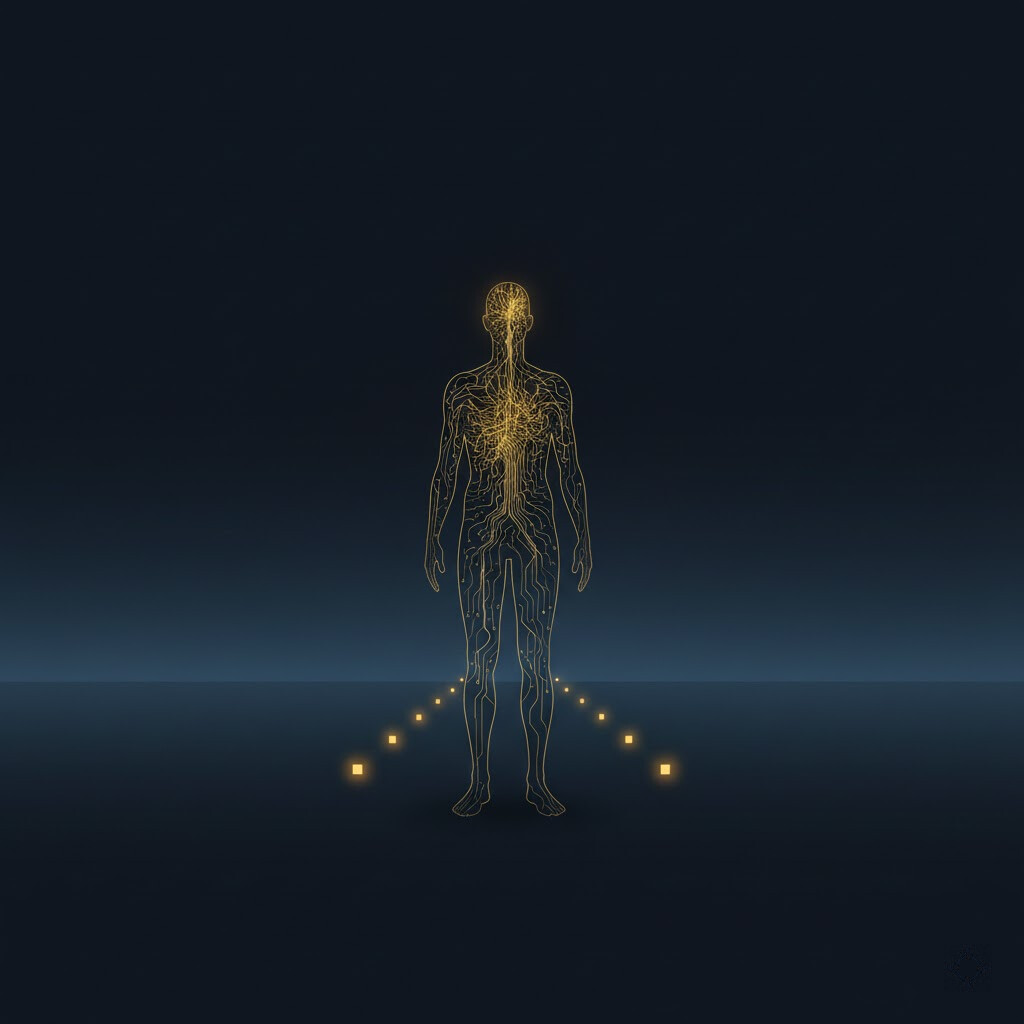
It is early February 2026. One year ago, almost to the day, I was on an operating table at the Pitié-Salpêtrière, with a team of neurosurgeons in my skull and my parents in a hallway. Today, I'm writing these lines with electrodes in my brain, a device under my skin, a cable connecting the two, and a life that no longer quite resembles the one before.
This post is not a definitive assessment. It's too early for that. It's a snapshot taken at a given moment, with positives, negatives, and many things I haven't yet finished understanding.
I am a cyborg
Might as well start with that, because it's true, and it makes me smile every time I think about it. I have metal in my skull, an electrical pulse generator under the skin of my chest, and a cable running under the skin of my neck to connect everything together. My brain constantly receives an artificial electrical signal that modifies how it functions. By definition, I am a cyborg. A real one.
This is not science fiction, this is not a metaphor. This is my Tuesday morning. I wake up, I have my breakfast, and meanwhile, a medical device sends current into my globus pallidus internus so that my muscles stop doing whatever they please. If that's not being a cyborg, I don't know what is.
There is something profoundly strange and profoundly mundane about this reality. Strange because the very idea remains dizzying when you think about it too long. Mundane because in daily life, it just becomes your life. The device becomes part of you, the electrodes become part of you, and the current running through your brain becomes part of you. The cyborg is me, and me is the cyborg.
The device
One year later, the device is still there. Obviously, it's still there, it wasn't going to leave on its own. But what I mean is that you can feel it. The scar on the chest has faded, it no longer pulls like it did in the first weeks, but the device itself remains perceptible under the skin. When you run your hand over it, you feel a hard rectangle, an object that has no place in a human body and yet has become an essential piece of your machinery.
And then there's the recharging. The pulse generator is a rechargeable device, which means that regularly, you have to place a magnetic charger on your chest and wait for the battery to fill up. It's a little ritual that settles into your life, like charging your phone, except the phone in question is inside your body and if it runs out completely, it's not your emails that stop, it's your brain stimulation. That puts things in perspective.
You get used to it. You integrate the recharging into your routine, you monitor the battery level, you learn to anticipate. But there's always that little moment, when you place the charger on your chest, where you remember that your brain functions thanks to a device that needs to be plugged in.
The cable
The cable was the unpleasant surprise of the first year. This wire that runs under the skin of the skull, goes down behind the ear, follows the neck and joins the device in the chest. In the first months, it was hypersensitive, every head movement drew my attention to it. One year later, it's better. Not perfect, better. There are still days when it pulls, positions that wake it up, moments when you feel that foreign presence under the skin reminding you that there's wiring down there. But most of the time, it fades into the background. The body has finally admitted, if not accepted, that there's a tenant in the neck.
The movements
The recovered movements I talked about in the previous post are still there. They've even become normal, which is perhaps the greatest victory. I no longer think about the fact that I brush my teeth with one hand. I just do it. I no longer congratulate myself for pouring water without spilling. I just pour. Normalcy has become normal again, and it's extraordinary precisely because it no longer is.
But there are also new movements appearing, small things I discover I can do and that I hadn't even identified as impossible before, so much were they part of the landscape of the illness. The body continues to recalibrate, one year later, and there are still surprises. Good ones.
There are also limits that remain. The stimulation hasn't erased everything, and it's important to say so. The myoclonus is reduced, not eliminated. The dystonia is diminished, not abolished. There are still bad days, moments when the body reminds you that it's wired precisely because it doesn't work as it should. DBS is not a cure. It's a tool, powerful, transformative, but a tool.
Explaining DBS
There's an aspect of life with a DBS that you don't think about before you have one: explaining it to others. Because it's somewhat visible (the scar on the skull, the device you can sometimes make out under a t-shirt), and especially because people ask questions. Or don't ask them.
That's what's most striking: people are polarized. There are those who are afraid, who change the subject, who look away from the scar, who don't want to know because the very idea of having electrodes in the brain terrifies them. And there are those who stay silent, who don't dare ask, who walk on eggshells because they don't know if it's a topic you can bring up.
Me, I love explaining. I love telling people how it works, why it's there, what it does, what it doesn't do. I love seeing eyes widen when I say there's current running through my brain at all times, and I love even more the moment when the person across from me understands that it's fascinating rather than frightening. DBS is not a taboo subject for me, it's a fascinating subject, and I will never tire of talking about it. So ask your questions. All your questions. The naive ones, the technical ones, the weird ones. I'd take someone asking "but doesn't it hurt?" a thousand times over someone crossing the street to avoid me.
What changes in life (and what you don't think about)
Having a DBS is not just a motor benefit and a device to recharge. It's also a series of practical constraints that nobody imagines before experiencing them.
No more MRI. Except under very specific and very controlled protocols, magnetic resonance imaging is off limits. The magnetic field and electrodes in the brain don't mix well. Which means that if one day I need a diagnosis that requires an MRI, an alternative will have to be found. You don't think about it on a daily basis, until the day you need one.
Airport security gates. It's dangerous to walk through security gates. Every time. I have a card that explains I have an implanted medical device, and generally it goes fine, but there's always that little moment when you hand your card to the security agent and wonder if they'll understand or if you'll end up in a side room explaining that no, you're not carrying suspicious metal, it's just that your brain is wired.
The head. Being careful not to have accidents to the head. Obviously, you're not stupid, you don't bang your skull for fun. But when there are electrodes inside, caution takes on another dimension. A violent impact could displace an electrode, damage the device, create a problem that didn't exist before. You think about it in stupidly mundane situations: a cabinet door left open, a passage that's too low, a sudden movement. You develop a skull vigilance you didn't have before.
And then there's the permanent awareness of having something in your body that you don't control. The device works, the electrodes stimulate, and all of it happens without you having a say. You don't control the current, you don't feel the pulses, you don't know exactly what's happening inside your own brain at any given moment. It's a continuous act of trust, a permanent delegation to a machine. Most of the time, you don't think about it. And then there are moments, late at night, in the silence, when you remember that your brain functions thanks to a device, and it's dizzying.
The nighttime awakenings
I need to talk about this too, because it would be dishonest not to.
Six years ago, well before DBS was a concrete option, I had a nightmare. One of those that stays with you. I had dreamed that they removed my brain to replace it with electrodes, some kind of incandescent light bulb filaments that took up all the space in my skull. I had woken up in a sweat, heart pounding, with the visceral certainty that someone had tampered with the inside of my head.
Six years later, there are indeed electrodes in my head. The nightmare became reality, except that the reality is therapeutic and the nightmare wasn't. But the brain doesn't always make the distinction.
It happens that I wake up at night and think: "BUT I HAVE ELECTRODES IN MY HEAD." Just like that, suddenly, without warning. You were sleeping peacefully, and then a part of your brain decides to remind you at three in the morning that the other part of your brain is wired. It's a panic attack in miniature, a jolt of consciousness that shakes you and takes a few minutes to dissipate. You rationalize, you calm down, you remind yourself that everything is fine, that it's normal, that it's there to help you. And then you fall back asleep. Until next time.
And then there's the fear that the electrodes will fall out. I know. It's ridiculous. They're fixed, screwed in, implanted, they're not going anywhere. They're not going to slide out of the brain like a poorly pushed cork. But irrational fear doesn't need logic to exist, and it has happened to me, in a half-sleep, to wonder if the electrodes were still in place, the way you automatically check that your keys are in your pocket. Except here, you can't check. You trust. Again and always, you trust.
Relearning who you are
This is perhaps the most unexpected part of this whole adventure. One year after the surgery, I'm no longer quite the same person, and I'm not just talking about the motor side.
For thirty-five years, I built myself with the illness. My strategies, my compensations, my limits, my reflexes, my way of approaching the world, all of it was constructed around a body that malfunctioned. And now that the body functions differently, that entire inner architecture has to be revised.
People sometimes ask me: "And what if one day you wanted to have it removed?" The answer is simple: why? I approached this surgery a bit like my disability: it's irreversible, and that's perfectly fine. My disability, I didn't choose it, but I integrated it, I built with it, it's part of me. DBS, I chose it, and it's part of me too. Technically, the electrodes could be removed. But why? It would be like asking someone who can finally see properly if they want their glasses taken away. No thanks.
And then let's be honest on the medical side: removing the electrodes is not trivial. Over time, fibrosis forms around the electrodes implanted in the brain, scar tissue that envelops the hardware. Removing them means tearing out something the brain has integrated into its structure, with all the risks that entails. It's not like unplugging a socket. It's potentially dangerous. One more reason not to think about it, and one more reason to be at peace with the definitive nature of the thing.
And this is where I want to insist, because it's perhaps the most important thing I've understood in this whole story. In my life, between my disability and my DBS, I've been faced twice with something you can't really choose. You can only integrate. The disability, I didn't choose it, it arrived, it was there, I had to deal with it. DBS, I chose it, but once it's done, it's done, and the choice no longer exists. In both cases, there's only one possible direction: forward.
So, well, I integrate.
"Did you make the right choice?" "Are you managing your disability well?" These are non-questions. Considerations of a snapped bungee cord. And unlike questions of philosophy, ethics, or metaphysics, you can't think them over. You can only live them. The cord is cut, you're at the bottom of the bridge, it's over, you don't go back up. I did it, I'm managing, I had the choice, I took it, I no longer have it, and at least it's done. I couldn't have made more effort. Nobody can ask more than that of anyone. And certainly not of someone who agreed to have their skull drilled open to plant electrodes in their brain.
But the question touches on something deeper: identity. Who am I, now? The same man with an extra tool? Someone new? A mix of the two? I'm not sure I have the answer, and maybe that's normal. What I know is that the limits have shifted, that impossibilities have become possibilities, that movements I had crossed off my life have come back, and that all of this needs to be relearned. Redefining what I can do, what I can't do, and above all what I want to do now that the cards have been reshuffled.
I'm right in the middle of it. I'm relearning my limits, and they're no longer the same. It's dizzying and it's exhilarating, and I haven't yet finished understanding where they are. It takes time to inhabit a body that has changed its rules, even when the change is for the better.
Too early to conclude
I won't make a definitive assessment. Not today. There is far more positive than negative, that much I can say. DBS has transformed my daily life in concrete and measurable ways. But one year is short. The brain is still adapting, the adjustments can still evolve, and I myself am still trying to understand what this surgery has changed, beyond the movements and the symptoms.
What I know is this: I have regrets. Of course I have regrets. I regret the bad moments, the months of fog, the nausea, the dizziness, the nights when I woke up in a panic with the absurd certainty that the electrodes were going to fall out, the humiliating preoperative tests, the specialist in Montpellier, the three a.m. awakenings. I regret every moment of needless suffering. But now, they're behind me, and they've passed. And regretting something that has passed serves no purpose. It changes nothing, it erases nothing, it fixes nothing. So I file them away, and I move forward.
And moving forward means focusing on the positives. Because there are positives, and they're concrete. I stand up straighter. That sounds like nothing, put that way, but when your dystonia has twisted your torso for thirty-five years, straightening up is an event. I have far fewer myoclonus episodes, and the ones that remain are dampened, manageable, bearable. My voice is steadier, more stable, less disrupted by the tremors that used to make it shake. I can eat in public more easily, without that permanent concentration to avoid spilling, without that constant tension to bring the fork to my mouth without incident.
And there are still further improvements expected. The adjustments continue, the brain continues to adapt, and the medical team estimates that the benefit can still increase. One year is a lot, but for DBS in dystonia, it's still the beginning of the story.
Would I jump again? Yes. With apprehension, yes.
To be continued?