
Building a life on shaking foundations
The first two posts were about the disease: what it does to the body, what goes wrong in the brain, why medication doesn't change much. This one is about everything else. About what you do with your life when your body won't cooperate, when the way others look at you weighs as much as the symptoms, and when you decide to push forward anyway.
"You're shaking!"
The first memory is from preschool. We're coming back from an outing with a friend, we're in the car, and she looks at me and says: "You're shaking!" Three syllables. She doesn't say it meanly—she's just stating a fact. Next to us, my parents try to shush her, change the subject, sweep it under the rug. But it's too late. The words are out, and they've done their job. It's the first time I understand that my body is doing something other people notice, something that isn't normal, something that sets me apart from the rest of the group. I'm four or five years old, and I discover that I'm different through someone else's eyes.
I remember that moment with total precision. Who, where, when. The car, the friend, my parents' embarrassment. And above all, the feeling. The feeling of realizing that the world sees you differently, and that it's never going to stop.
Adolescence—already tough for everyone
Adolescence is a universal ordeal. For a teenager with myoclonic dystonia, it's that ordeal squared. The body changes, social codes harden, and the slightest deviation from the norm is punished.
It was during this period that my hand could no longer keep up with writing. Writing with a pen on a sheet of paper—that mundane gesture everyone does without thinking—became a losing battle. The technical solution came in the form of a laptop. At a time when nobody had one in class, it was yet another marker, yet another difference on display for all to see. A necessary tool, but one that nobody around me understood, and that many found suspicious or unfair.
Middle school, or how an institution can destroy you
I'll be blunt about this period, because there's no elegant way to tell it.
Middle school was a disaster. Not a rough patch, not a difficult phase. A disaster. The institution as a whole, from floor to ceiling, from the students to the adults supposedly in charge, was rotten to the core.
If you knew me back then, whether you were a student or a teacher, there's a 99% chance you made my life hell. I say it straight. But rest assured: I won't give you back what you gave me. At least, not as long as you don't come looking for it. If you stay in your corner, I stay in mine. If you come find me, we'll talk again, and the conversation won't be the same as it was back then.
Maybe you've changed since. I sincerely hope so. But in my eyes, it's the version of you from back then that counts, and that version missed something important. You had the chance to be decent to someone who was different, and you weren't. You've probably become less stupid since then, and good for you.
As for the teachers from that time: you probably finished your career the way you ran it, and some of you finished your lives the way you lived them. I have neither compassion nor respect to offer on this point. That's epitaph enough.
In both cases—former students or former teachers—I've heard about you one way or another over the years. And what I've learned confirms my belief that life trajectories end up reflecting what people carry inside. Your lives didn't go well. I know it, and I take pleasure in it without the slightest embarrassment. It's not cruelty—it's satisfied lucidity.
And while I'm at it, one last thought. Given the level of that school, given the human quality of the people who operated there, I think life will deliver a form of justice I don't even need to seek. The day your own children find themselves facing people even more harmful than what you were, and you're unable to protect them, you might understand what it's like to be vulnerable in a hostile environment. Or maybe not. Either way, it won't be my problem anymore.
Rebuilding, one high school at a time
And then came high school. And high school was a different story.
I'm not saying everything was perfect, I'm not saying the stares had disappeared, I'm not saying there was nobody left to complicate things. There still was. But there was also room to breathe, people to build with, an environment that left space for something other than social survival. High school was the beginning of a reconstruction—slow, fragile, but real. The pleasure of learning could exist again, and that's a luxury whose value I fully appreciate when I think back to what came before.
Preparatory classes, precisely because I'd been told no
After the baccalauréat, I enrolled in a classe préparatoire. And the reason I did it is precisely the reason people told me not to. I was told it would be too complicated, too demanding, too difficult for someone in my situation.
When you've heard that kind of thing your whole life in various forms, it ends up producing the opposite of the intended effect. My motivation has never worked the way other people's does. Telling me something is out of reach is the best way to make me want to go get it.
The prépa wasn't easy. It's not easy for anyone, and even less so when your body adds its own layer of difficulty. But I did it.
Engineering school—the one I wanted
After prépa, I got into the engineering school I was aiming for. Not a default school, not a plan B. The one I wanted. That's not a detail. When you've been told for years that things would be too hard for you, getting exactly what you chose has a particular flavor that only those who've had to fight twice as hard for the same result can understand.
The PhD, on disability and computer science
The journey continued with a doctoral thesis, and its topic was no accident: disability and computer science. When you've lived in a body that won't do what you ask since childhood, and you've spent your entire education finding technical solutions to compensate for what the body can't do, working on this subject isn't some abstract academic choice. It's the logical continuation of a lifetime of adaptation.
The constant small obstacles
There's a common thread running through this entire journey, from preschool to the PhD: everywhere, at every stage, there were people trying to make things harder. Massively in middle school, a bit less in high school, still in prépa, in engineering school too, and even during the PhD. The form changes, the faces change, but the mechanism stays the same: someone decides your difference is sufficient pretext to put obstacles in your way.
To those who might recognize themselves in these lines, I have only one message: not only did you fail, but your ears will be ringing for a long time. All you managed to do was make me more determined, and that's probably the opposite of what you were going for.
The remarkable people
But it would be deeply unfair not to say what matters most: in the face of these obstacles, there were also, at every stage, remarkable people. People who understood, who helped, who opened doors instead of closing them, who saw the person before the disability.
And since these people deserve to be named, I'll name them.
Mr. Jack Sagot, a teacher-researcher who followed me from middle school to today, and who is and will remain an exceptional man. It's thanks to him that I had a computer in class at a time when nobody understood why it was necessary. Without him, nothing that followed would have been possible in the same way.
Mr. Négrié, Ms. Perset, Ms. Nadal, Ms. Romerosa, Mr. Andrieu, Ms. Deltort—my tenth-grade teachers, the first to treat me as a capable student and not as a case to manage.
My high school friends: Grégoire, Matthieu, Vincent, Anthony, Simon, and the list goes on. Those who never looked at me sideways, who never pretended not to see, and who were simply there—normally, naturally, as if it were obvious. It wasn't, and I don't forget it.
Mr. Chabriac, my math teacher in PC* during prep school, who always encouraged me to do even more than the best possible. Mr. Dervaux, my French teacher in PCSI and PC*, for his respect, humanity, and the passion he shared with us throughout his lessons and discussions.
Mr. Groz and Mr. Viardot, in engineering school.
Mr. Bessière, Christelle Ginestet, Laure d'Assonville, Sophie, Jeanine, Marie—who held things together when it was needed, and whom I still run into with pleasure.
Paul Pitiot, my current director, who hired me, supported me, and held the reins without flinching when I told him I'd be away for six months for brain surgery.
And all those I don't mention here but who will recognize themselves: you were part of the solution, not the problem, and in a life where the problem is permanent, that's worth its weight in gold.
If they read these lines, let them know they matter as much in this story as those I've just taken apart. You don't build an entire life on rage alone. You also build it on the trust that a few well-placed people had the generosity to grant you.
The rage, and what it became
This rage I've been talking about since the beginning of this post is more or less over now. What extinguished it wasn't time—it was building something. Today, I'm a teacher-researcher, holder of a doctoral thesis, a computer engineer. This triple label easily takes precedence over "disabled," though I don't hesitate to use that one too when the situation calls for it. One doesn't erase the other, but the hierarchy has flipped: it's no longer the disability that defines me in people's eyes—it's what I made of it.
That said, even if my rage no longer expresses itself the same way, it hasn't disappeared. It's transformed. It's become an energy directed toward others—toward those living today what I lived yesterday. Young or not so young, diminished or disabled, people who get idiocies thrown in their faces by fools who'd do better to shut up. People who are told what they can't do, instead of being helped to find what they can do differently.
If you or your child are disabled (I don't like the expression "in a situation of disability"—you're disabled, period, and the word isn't an insult) and you need advice, guidance, or support that a computer scientist could provide, my door is open. It's not charity—it's solidarity between people who know what it's like to fight with a body that won't cooperate.
Switzerland, the bungee cord, and the turning point
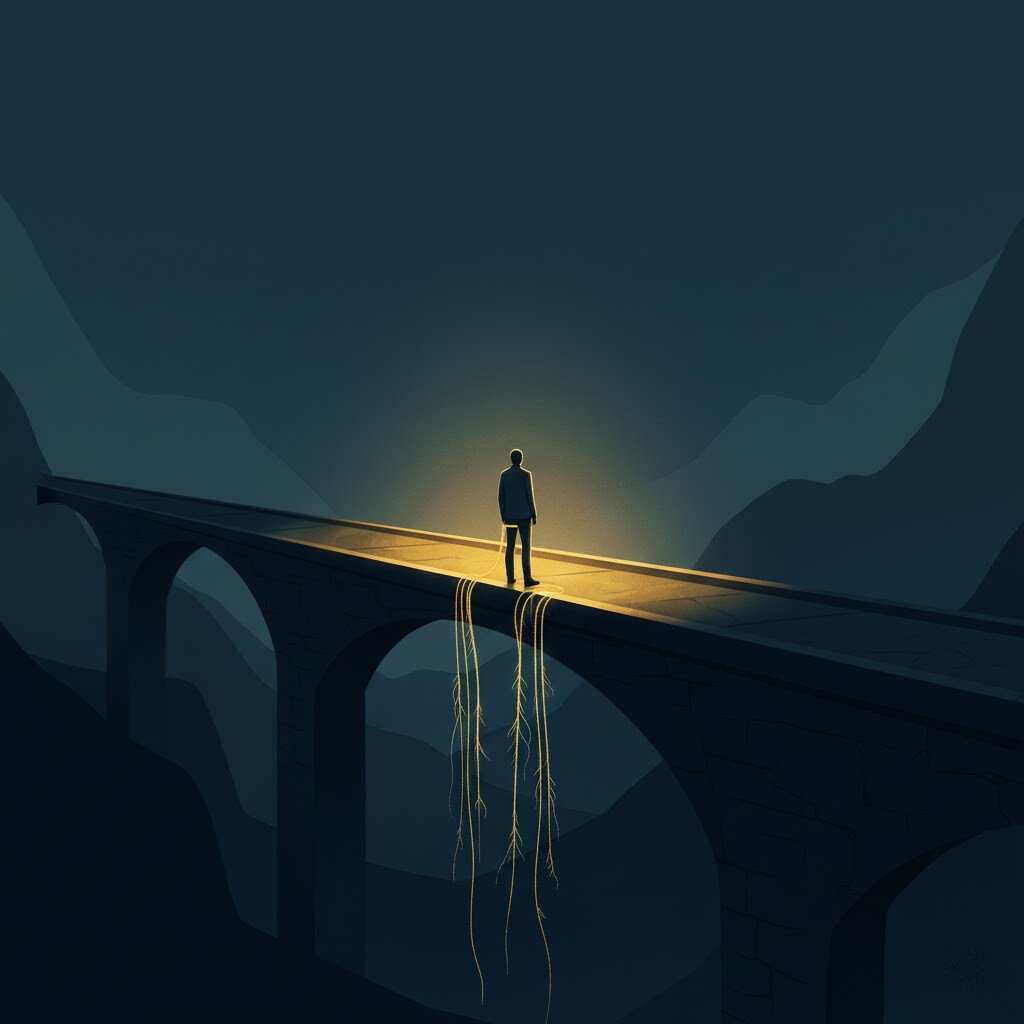
It was in Switzerland, during an engineering internship, that something changed in the way I see disability. Not in the symptoms, not in the body, but in the mind. For the first time, I was able to put words to what I'd always felt, and those words took the form of an image I've called ever since the theory of bungee jumping without a bungee cord.
The idea is this.
Imagine you're bungee jumping. If you spend the entire jump wondering whether the cord will hold, you'll ruin the jump for nothing. You'll have been afraid for no reason, you won't have felt anything good, and the cord held perfectly fine. You'll have poisoned the experience with the fear of a scenario that never happened.
Now imagine you know the cord is flawed. That it has a manufacturing defect, that it could snap. What do you do? You don't jump? You stay on the bridge watching everyone else jump?
Living with a disability is exactly that. You know the cord is damaged. You know it might give way. And that's precisely why you have to jump. Because staying on the bridge isn't living—it's watching others live.
And here's what nobody tells you: knowing the cord is fragile gives you an enormous advantage over those who've never thought about it. Most people spend their lives hesitating at the edge of the void, paralyzed by fears they can't name. We know fear. We've lived with it forever. We know exactly what it is, and we jump anyway. That lucidity is a strength that nothing can give you except the experience of lacking, of limits, and of the deliberate choice to charge forward despite everything.
To be continued.