
"Oh, for you, that'll do..."
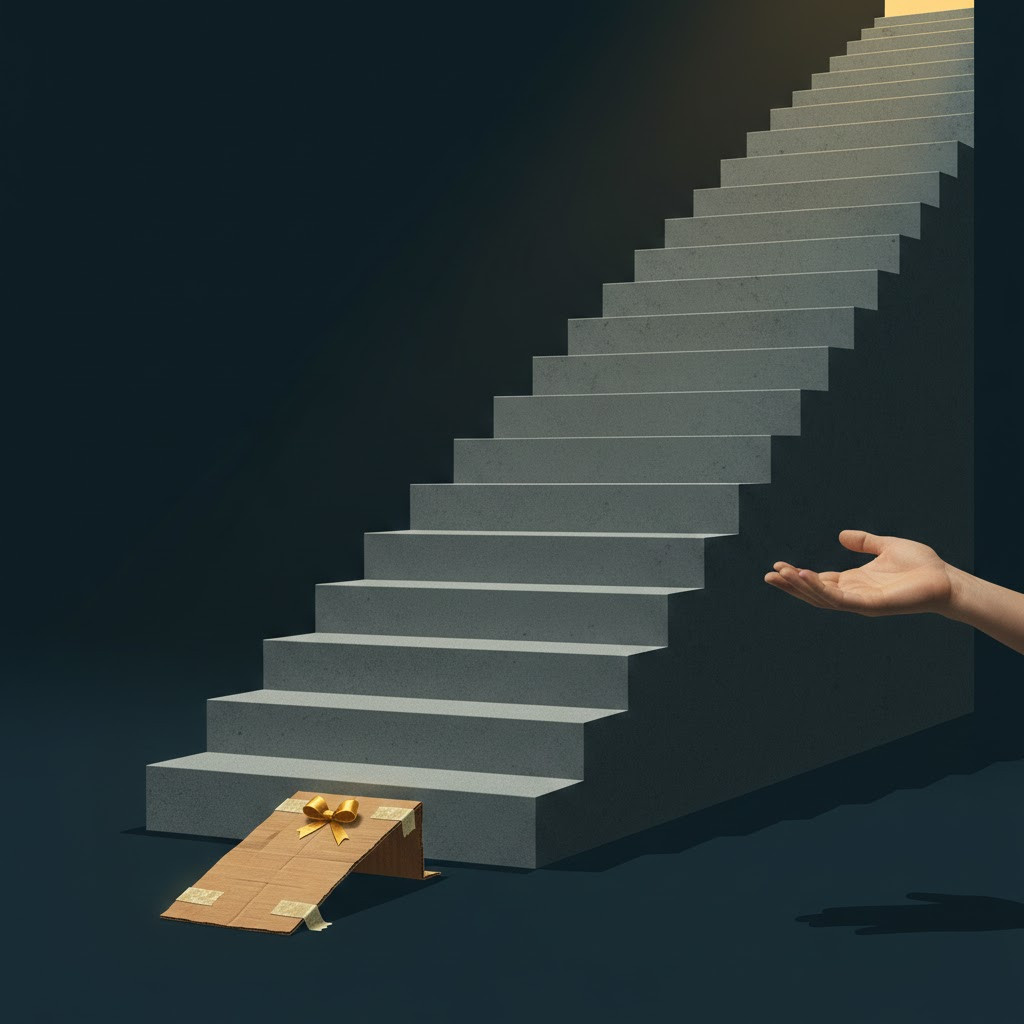
Or how invisible disability makes goodwill visibly absent.
One day, I'll write my autobiography. It'll be called like this article. Because I've heard this sentence so many times, said in so many different tones, by so many different people, in so many different contexts, that it's become the soundtrack of my life with disability.
"Oh, for you, that'll do."
Six syllables. A shrug. A polite half-smile. And a lifetime of fighting for crumbs that are presented to you as a feast.
I have myoclonic dystonia. When your disability is invisible, it becomes optional in people's minds. It exists when it suits them, it disappears when it inconveniences them.
The catalogue
What follows is not fiction. It's not a dystopia (even though, technically, it's a dystonia). It's my schooling. My journey. My studies. My internship search. My professional life. A collection of sentences spoken by people in positions of authority, in public institutions and private companies, to a pupil, a student, then a candidate whose only fault was asking for what he was entitled to.
I kept them all. Not out of resentment. Out of sheer disbelief.
Middle school: the special privilege
To understand what follows, you need to understand what happened in my body between the ages of eleven and twelve.
Myoclonic dystonia is linked to a mutation in the SGCE gene, which encodes a transmembrane protein of the dystrophin-glycoprotein complex, found in the basal ganglia, the cerebellum, and the cortex. Under normal conditions, this complex participates in the fine regulation of movement. In me, it malfunctions. And at puberty, everything got worse.
The surge of gonadal hormones (testosterone, estradiol) directly modulates GABAergic and dopaminergic neurotransmission in the basal ganglia, the exact structures that go haywire in DYT11 dystonia. Add to that the growth spurt, the massive neuronal reorganization of adolescence, the brain plasticity reconfiguring at full speed, and you get a body that, within a few months, loses what little fine motor control it had left.
In sixth grade, I started falling behind in writing. In seventh grade, I stopped entirely. Not by choice. Not out of laziness. Because when I try to write, my muscles contract chaotically, my pen presses too hard, the line veers off, the paper tears under the tip. And when I push through, I pull muscles. Literally. Writing three lines means risking a cramp in my arm, my shoulder, my neck. My body interprets the act of writing as a violent effort and responds accordingly.
Since my deep brain stimulation was implanted, it's better. I can make an X to sign my name. An X. Wonderful.
My integration into middle school was a failure. A real failure. A failure, failure, failure.
The administration: two years for a keyboard
Bonus points to the French administration, which did everything it could to slow things down. The diagnosis was made in sixth grade. Getting a rare disease diagnosed in an eleven-year-old is hard enough. But fine, it's done. Then it took a year to obtain THE RIGHT to have a PC. A year. Twelve months. For them to authorize me to use a tool that would let me follow lessons like everyone else. That brings us to seventh grade.
Then another year to validate using the PC during exams. Because having it in class is one thing. Having it during tests is another. It's a different form, a different circuit, a different approval. That brings us to eighth grade.
Two years. Two years of procedures to arrive at what should have been the starting point: a kid who can't write is allowed to use a keyboard. Revolutionary.
The PC we bought ourselves
And the PC itself? Guess who bought it. Not the school. Not the regional education authority. Not the ministry. My parents. Out of their own pocket. Because if we'd waited for the institution to provide the equipment, I'd have gotten it in ninth grade. Or in tenth. Or never. We learned the lesson fast: at every new institution, we'd have to start over. Buy again, supply again, justify again. Disability doesn't come with a welcome kit. It comes with a chequebook.
The teachers: the football match
Meanwhile, the teachers. I had the same ones from sixth grade through ninth. The same ones. Not newcomers who might have missed the memo. Not substitute teachers parachuted in mid-year. No: the same teachers, in the same classrooms, year after year. They saw me in sixth grade starting to fall behind in writing. They saw me in seventh grade showing up with a PC on my desk. And they were told. There were meetings, explanations, presentations of the situation. My parents came in, talked, showed the paperwork. Except that some teachers, when told about these meetings, responded with things like: "Is it really mandatory? I've got a football match that evening." A football match. Versus understanding why one of their students can't write. Football won. The kid they'd known for a year showed up one morning with a keyboard and they chose not to know why. Nobody understood. Nobody. The ones who'd attended the meetings pretended to understand, nodded along, and changed nothing. The others didn't even pretend. And rather than adapting, asking, genuinely trying to understand, they acted as if nothing had happened, or worse, they stared at the computer like a foreign body in their classroom. The same teachers. Four years.
The recorder
I remember music class. We had to play the recorder. That instrument every schoolkid hates and that I physically could not hold. My fingers didn't cover the holes properly, my hands were shaking, the sound that came out resembled a seagull in distress. Nobody wondered if, maybe, some adaptation was needed. Nobody thought "hey, this kid who can't write, maybe he also can't play an instrument that requires fine motor skills." They put the recorder in my hands and waited for it to sound right. It never sounded right.
The cheater
In eighth grade, finally, the PC was approved for exams. First test of the year. You'd hope it wouldn't be a dictation. It was a dictation.
And that's when something twisted took root. I was a good student. Before the PC, I was already a good student, with my illegible papers, my crossed-out lines, my torn sheets. My grades held up despite everything. And now that I was finally given an adapted tool, now that my papers were legible, my answers clear, instead of thinking "ah good, he can finally show what he knows," they implied the opposite. They implied that my good results from before were legitimate, but the ones after were suspicious. That I wasn't maintaining my results. That I was cheating now.
The PC hadn't freed a good student. It had created a cheater.
The headmaster: "special privilege"
It was in this context that the headmaster of my middle school dropped the word. Special privilege.
We were in his office. My parents were there, with the file, the medical certificates, the recommendations. Everything you need to prove you're not lying. Because that's the first step when you're disabled: proving you're not faking it. The headmaster listened. He leafed through. And then he used that word. Special privilege. Just like that, naturally, as if he were describing what he saw. As if receiving extra time or a computer when your hands refuse to obey you was institutionalized cheating. As if the 2005 French Disability Act was some kind of cheat code you activate on the sly to skip levels without effort.
The headmaster of a school, the very person responsible for ensuring the inclusion of all his students, was looking at my accommodations as an undeserved privilege. In his office. In front of my parents. In front of me. And nobody in the room was supposed to find that abnormal.
The IT teacher and the broken wrist
And then there was this IT teacher. In eighth grade. I'd broken my wrist. A broken wrist, the kind of thing everyone understands, that hurts, that shows up on an X-ray, that requires no additional certificate, no explanation, no disability paperwork. Just a cast and a self-evident fact: this kid can't write. Even less than usual. You'd think this would be the moment when, for once, nobody would question my need for a computer. That even the most sceptical would think "alright, come on, this time at least." You'd think.
She looked at me and said: "I'm banning you from the PC because you'll cheat with it."
Cheat. With a computer. In IT class. Under her eyes. Sitting in the front row. With a wrist in a cast. In eighth grade, the very same year I'd finally been authorized to use the PC in exams after two years of procedures. And there she stood, in front of me, absolutely convinced that if I were given a keyboard, I would immediately... what, exactly? Google the answers on an IT test? Send emails to the CIA? Hack the school network from her classroom? I never found out what she was imagining. But she was imagining it hard. And the message was crystal clear: even with a cast, even with a condition, even with two years of administrative paperwork, the first assumption when facing disability is fraud.
There was plenty more nonsense at that school. Plenty more sentences, plenty more looks, plenty more moments. But out of charity, and to avoid running out of time with the idiots from other periods of my life, I'll spare you.
High school: the threats
Year 10: the exception
But first, year 10.
Year 10 was the best year of my education. A real group of friends. For the first time. After four years of middle school without any, it feels strange to say. Guys, if you're reading this, thank you so bloody much. ❤️
And teachers who got it. Not "sort of got it." Not "got it after three meetings and a registered letter." Got it. From day one. Without anyone having to fight.
I thank them all. Yes, all of them. ALL. Every single one of my year 10 teachers. M. Andrieu, history and geography, a seasoned old hand, warm and kind, who looked at me like a benevolent uncle or grandfather. Mme Deltort, French, superb, the one who made you love French. Mme Nadal, biology, brilliant, she made everything accessible. M. Négrié, physics and chemistry, humanity and empathy, the one who made me want to do physics. Mme Perset, head teacher and maths, lovely and a great listener. Mme Romerosa, English, cynical humour, integrity and a heart of gold.
Those people did in one year what middle school hadn't managed in four. They treated me like a student. Not like a case file. Not like a problem. Like a student.
The headmaster at the time, by the way, had this magnificent remark to my parents: "What nerve, they come in for a disabled student, and they've brought the healthy twin." I still laugh about it. A little bitterly, but I laugh.
A nod to Sabine, the secretary, who will probably read these lines: why do you think I still come back to the school with pleasure? You're part of that incredible team.
If all teachers were like my year 10 teachers, this article wouldn't exist.
Except that not all teachers are like my year 10 teachers.
"I'll make sure of it!"
In high school, the stakes went up a notch. The accommodations were the same file, the same procedure, the same letters. But the teachers changed. And every new teacher meant a new explanation, a new dubious look, a new negotiation over things that should never have been up for negotiation.
One teacher, upon learning I would have accommodations for the baccalauréat (the national school-leaving exam), felt called to a mission. He didn't say it right away. He waited. And one day, in class or in a hallway (you never remember exactly where these sentences land, but you remember every syllable), he told me, with the look of someone warning a burglar that he's installed cameras:
"On exam day, it won't be the way you think. I'll make sure of it!"
I'll make sure of it. He'd said it with a sort of pride, as if he'd uncovered a conspiracy of national proportions. As if my accommodations were a Machiavellian plot that he, heroically, was going to foil. As if he were the last bastion of French meritocracy, standing against a teenager who trembled when he wrote.
The exam invigilator: "I'm the one who decides"
And on exam day itself. The real day. The one you prepare for over months, years. We'd done everything by the book. The full chain: school headmaster to the regional education authority, the authority to the ministry, the ministry sending the authorization back down to the school. Approved, stamped, official, indisputable. The kind of file that passes through so many hands that even Kafka would find it excessive. Everything was in order. We had the paperwork. We had the stamps. We had everything.
And then the invigilator arrived. That morning. On time. He saw the file. He read it. And he said, as calmly as you please:
"I don't care about the ministry. I'm the one who decides."
Let that sink in. Months of procedures. Registered letters, forms in triplicate, signatures from doctors, headmasters, education officials. A complete chain of validation from bottom to top, then top to bottom. And a bloke with a badge around his neck, one morning in June, decides that none of it is worth anything. Because he's the one who decides. Not the ministry. Not the law. Him. The French education system in all its glory: a pyramid of approvals that crumbles on contact with a self-appointed gatekeeper who decided, that Tuesday morning, that he was above the state.
Fortunately, the school's headmistress stepped in to "correct" this excess of zeal. But she had to step in. Two days before the exam. Without her, I'd have had no PC, no scribe. For the baccalauréat. After years of procedures. You'd laugh. If it happened to someone else, in a film, with a comedic soundtrack. But it was me, it was real, and there was no soundtrack.
Preparatory school: the suspicion
Preparatory school. In France, "prépa" is a brutally intensive two-year programme that prepares students for competitive entrance exams to elite engineering schools. A place where they tell you that suffering builds character, and where they take that so seriously they make sure everyone suffers. But some a bit more than others.
Before I get into the horrors, let's give credit where it's due. There were those who picked up what the institution let fall. M. Chabriac, maths teacher in the advanced track, brilliant. M. Dervaux, French teacher across both years, the best French teacher I ever had. Mme Levesque, English teacher. Strangely, it's the language teachers who are the least annoying and who catch on the fastest. Make of that what you will.
Special mention also to Mme Marquet, physics teacher in the advanced track, whom I didn't have as a classroom teacher but only for oral exams at the time, and whom I see again every year with the greatest pleasure — she's an absolute sweetheart.
But back to the horrors.
The honeyed speech
First, there was the honeyed speech. Not a frontal attack, no. Something more insidious. A programme director, with the paternalistic tone reserved for children and the disabled (often the same, in the collective imagination), took me aside. He seemed sincerely concerned. Sincerely benevolent, even. And he explained, in a confidential tone, as if he were doing me an immense favour:
"Eh, exam accommodations, that'll isolate you from the others. And prépa is a tight-knit team. Your little classmates will be happy to see you succeed on your own merits rather than through the administration's favours."
I invite you to reread that sentence. Slowly.
A programme director, whose job it was to welcome me, telling me that my classmates would be happy to see me struggle without accommodations. That giving up my rights was a gift I'd be making to the group. That my "little classmates" (the diminutive alone does a lot of heavy lifting) would prefer to watch me fail with dignity rather than succeed with help. And that my accommodations, validated by law, prescribed by doctors, were not rights but "the administration's favours." Favours. As if the administration were offering me chocolates. As if extra time was a special privilege, a leg up, a cosy little arrangement between friends. And the crowning touch: he dressed it up as solidarity. He was selling me the surrender of my rights as an altruistic gesture. "Do it for the others." Not "do it because it's fair," not "do it because those are the rules." No: do it so your classmates feel comfortable. So they don't have to ask questions. So the system doesn't have to adapt. Give up, and everyone will be happy. Except you, but you're used to that. And I was the bolt that wouldn't fit the thread of his "tight-knit team."
The trio of four
Speaking of tight-knit teams. In prépa, oral exams called "khôlles" are done in groups of three. Three students, a blackboard, an examiner. Except my trio was a quartet. Because they'd stuck me into a group of three as a surplus, like an extra passenger. The reason, unofficial but obvious: "He won't last two months anyway." No point giving him a real spot in a real group, since he's going to drop out. Might as well park him somewhere until he leaves. Spoiler: I didn't last two months. I lasted two years. And I still come back to teach there with pleasure.
The unfindable scribe
And then there was the scribe issue. In prépa, for monitored tests, for practice exams, for everything written under pressure, I needed someone to write for me. Logical. Except nobody provided one. I was told to sort it out myself. To find someone on my own, train them, bring them along. As if organizing your own accommodations was a core competency in advanced maths, somewhere between Fourier series and vector spaces. And when, after finding someone, training someone, getting someone up to speed, I asked whether this person could accompany me on the actual exam day, I was told, with magnificent detachment: "Well, you might not be allowed one on the day of the exam." Might not. Be allowed. On exam day. So what do I do, then? Write in invisible ink? Wait for a miracle? Pray to Saint Fourier for my hands to suddenly start working on the day that matters? Nobody had an answer. Nobody seemed to find it problematic. They were preparing me for a competitive exam while telling me they might take away the tools to sit it.
The forger
And then there was this teacher. The teacher. The one I'll remember for the rest of my life, the one I'll tell my grandchildren about, the one whose sentence is so staggering you have to read it twice to make sure you understood correctly.
When the question of adapting certain arrangements for my note-taking came up (not changing the content, not simplifying, just adapting the medium), he looked at me. At length. With a suspicion I will never forget, that slow suspicion that says "I see what you're up to." And he said, in dead earnest:
"You're going to take my course materials, falsify them and modify them. And you'll be the only one to know!"
Let me invite you to reread that. Take your time. Maybe a third time.
A preparatory school teacher, face to face with a disabled student who was simply asking to be able to follow his courses in viable conditions, imagines that the first thing this student will do is... falsify his teaching materials. Not copy. Not distribute. No: falsify. Alter the course content. In secret. And be the only one to know. As if the secret goal of every disabled student were an elaborate forgery scheme, an Ocean's Eleven of note-taking, an intellectual heist meticulously planned since nursery school.
I still don't know what I was supposed to do, specifically. Sell his handouts on the black market? Build an international trafficking ring for advanced maths course notes? Publish a pirated annotated edition: "with the real secrets the teacher doesn't want you to know"? Create a rival website with his worked solutions? I don't know. He probably didn't either. But he believed it. Hard.
The competitive exams: the circus
But the pinnacle. The Everest of the absurd, the K2 of administrative stupidity, the Mont Blanc of nonsense. The competitive exams.
Mines Ponts: the safe
My PC had been placed under seal the night before the first paper. Official procedure. We'd brought it in, shown it, checked it, switched it off, locked it in a safe, sealed it, signed it. Everyone had initialled. Everyone agreed. The PC was sleeping in its safe like a jewel at Cartier's, and the next morning, they'd take it out, switch it back on, and I'd sit my exam on it. Simple. Clean. Above board.
When the head invigilator arrived the morning of the exam and saw the safe, he had a moment. That moment when something twists in someone's gaze. He asked what was inside. They told him. And he nearly forced it open. Literally. An invigilator for a national competitive exam, ready to break into an official safe, sealed, signed, because a disabled candidate had a PC inside and that was obviously suspicious. They had to explain. Show the paperwork. Explain again. He wasn't convinced.
He turned to his colleagues and said, loud enough for me to hear: "You're going to cheat! Don't take your eyes off him."
That bloke, by the way, I'm still looking for his name. I have a few things to explain to him. Especially since, at the end of the last paper, he shook my hand and said, with a magnanimous smile: "Good luck with the exams. I hope you'll manage. Even you."
Even you. The "even" does all the work in that sentence. It's the word that turns encouragement into condolences. That says: I'm not betting on you, but who knows, miracles happen.
Fortunately, the director of studies, M. Joël Daste, had stepped in to try to get things under control. But the madman from the Mines Ponts exam bus had managed to pull one over on him. I don't think said head invigilator was appointed for another year.
Mines Ponts: the nine-square-metre room
And that's how I ended up in a room of 9 square metres. Alone. Well, "alone." With five invigilators.
Five. Human beings. Adults. Standing. In nine square metres. Five pairs of eyes for a single candidate. While the three hundred others sat their exam peacefully in their air-conditioned lecture hall with two or three proctors scrolling on their phones at the back of the room.
Me, I was watched like a prisoner in solitary confinement. Five people watching me write. Breathing. Shifting. Whispering. Except in solitary confinement, at least it's quiet. Because the head invigilator was making phone calls. In my exam room. During the paper. He'd pick up, talk, hang up, pick up again. His phone buzzed on the table. He answered in a low voice, then a less low voice. Because, well, it's not as if I needed to concentrate. It's not as if the exam mattered. It's not as if my future was being decided in that room.
And in the end, when I complained, when the situation became so Kafkaesque that even he must have sensed it was a bit much, he shrugged. That shrug I know by heart now. And he said:
"What's the problem, you've got a scribe!"
Mines Ponts: the scribe who couldn't draw a hexagon
A scribe. Yes. The person assigned because my hands can't write fast enough or legibly enough for a four-hour exam. Someone who was supposed to be my hands, write what I dictated, draw what I described. Supposed to.
Except that this scribe, in a chemistry exam, couldn't draw a hexagonal molecule. A hexagon. Six lines. The foundation of organic chemistry. Benzene, cyclohexane, the stuff you scribble with your eyes closed in science prep. He couldn't do it. Or wouldn't. I dictated, I described, I mimed with my trembling hands the shape I wanted on the paper. And what appeared on the page didn't resemble anything. He seemed to make a point of not understanding what I was saying. Maybe out of incompetence, maybe out of disinterest, maybe no one had simply told him that being a scribe involved listening to the candidate and not just filling the "accommodation" checkbox on the administrative form.
Spoiler: we didn't get a great mark in chemistry.
CCP: the forbidden scribe
For the oral research presentation (TIPE, an exam where you present a personal research project to a panel), I needed a scribe. I'd come with mine. Prepared. Organized. As usual, because after a while, you learn to plan everything yourself, since nobody else will do it for you.
I was told: "Nah, not allowed."
That was false. Completely false. But when you're a candidate, alone, stressed, facing people who look very sure of themselves and who say no with authority, you don't always have the energy to pull out the legislation, cite the articles, prove that you're right against people who are wrong but who have the power.
"So how am I supposed to manage, then?"
I'm the one who asked. Because it's always us who have to ask that question. Never them.
"Oh, we'll find you someone."
They found me someone. A stranger, parachuted in at the last minute, who knew nothing about my project, my disability, or me. Someone they'd probably grabbed in a hallway and told "here, go help the disabled guy."
Long story short. I was faster without him.
Engineering school: the obligation
After the competitive exams, the school. You'd think that once admitted, once the obstacle course was over, once you'd proved a hundred times that you were capable, things would calm down. That the system, having watched you survive all its hurdles, would finally welcome you normally. That it would think: "right, this one's earned his place, let's leave him alone."
You'd think.
Here too, there were people who corrected the institution's course. M. Sébastien Viardot, professor and director of studies, the reason I love software architecture. M. Roland Groz, networking professor, with excellent humour. Those two did what the administration refused to do.
Because the administration asked the question it always asks.
"Do we really have to?"
The administration's first reaction, when I presented my accommodation needs for the school's exams (the same accommodations I'd had since middle school, validated by the ministry, tested over years, absolutely not a surprise):
"Do we really have to?"
Three words. Really have to. Not "how do we do this?" Not "what do you need?" No: "Do we really have to?" As if the law were a suggestion, a vaguely binding recommendation you could ignore if it fell on a day when you didn't feel like it. As if "have to" were a phrase whose meaning changed depending on the mood of whoever read it. As if, at every stage of my journey, the first question was never "how do we help you?" but always "can we avoid helping you?"
The internship: the box
"God, what a pain in the arse, these people!"
Second year. Mandatory internship. I apply, like everyone else. CV, cover letter, suit and tie, the whole game. I arrive at the company. They sit me down in the lobby. They tell me to wait a moment.
I wait. I watch people walk by. I'm clean-shaven, well-dressed, CV under my arm. And then I hear the HR manager, the very one who's going to see me in ten minutes, the one who has my CV in front of him, the one who knows I'm in my second year of engineering school, talking with a colleague. Not discreetly. Not whispering. Just in passing, like commenting on the weather.
"There's a disabled bloke coming in. Probably for the reception desk. Or cleaning. God, what a pain in the arse, these people!"
I didn't say anything right away. I let the sentence exist in the air, settle. Then I asked, calmly, the name of the disabled candidate they were talking about.
It was mine.
I laughed. In the moment, I laughed. That reflex laugh that comes out when absurdity exceeds what your brain can normally process. I laughed, I stood up, I said something. I can't remember what, probably nothing memorable. And I left.
And in my car, or on the bus, or in the street, I can't remember, I cried.
Not from anger. Not from rage. From exhaustion. That very particular exhaustion that builds up when you realize you can get all the degrees you want, pass all the exams, tick every box, and at the end of the road, there will always be someone in a lobby who decides in three seconds that you're there for the cleaning because you're "a disabled person." That your degree, your journey, your intelligence, all of it vanishes behind one word. Just one. And that word isn't your name.
University: the verdict
"You won't be able to teach!"
And then university. Higher education. The place of knowledge, of open-mindedness, of research, of critical thinking. The place where, in theory, you train the people who will train others. The place where intelligence is supposed to come first.
A tenured professor. Not a harried adjunct, not an overworked teaching assistant. A tenured professor, established, who knows the system, who is the system. Upon learning that I was possibly considering teaching, she looked at me with the serene confidence of someone stating the obvious, a law of nature, something as incontestable as gravity, and she said:
"But you won't be able to teach!"
Not "it'll be a challenge." Not "we'll need to find adaptations." Not "here are the difficulties you might face." No. "You won't be able to." Full stop. Five words. The door, closed in advance. Locked. By someone whose job, whose literal job, the one she's paid for, the one she chose, is to open doors.
The common thread: suspicion
You'll have noticed: there's a thread running through all these stories. It's not the lack of resources. It's not the ignorance of the condition (that's forgivable; it's a rare disease). No, the common thread is suspicion. Distrust. The idea, embedded deep in the institution's bones, that disability is a scam and that accommodation is cheating.
And when it's not suspicion, it's the box. The disabled person is not an individual, they're a category. A line in a spreadsheet. A logistical problem. Reception or cleaning. Scribe or extra time. They don't ask "who are you?", they ask "where do we file you?" And if the box doesn't exist, you don't exist either.
Extra time isn't a gift. It's the time I need to do what you do naturally. A computer instead of a pen isn't comfort. It's the only way for me to produce legible text when my hands decide to go freestyle. An accommodation isn't a special privilege. It's the right, plain and simple.
But try explaining that to a system that looks at a disabled student and first sees a potential cheater. To an invigilator who sees a safe and thinks of a heist. To a teacher who sees a PC and imagines a conspiracy. To a headmaster who sees an accommodation and says "special privilege" the way you'd say "dirty word." To a recruiter who sees a disabled person and thinks "cleaning."
The real cheating is on the other side. It's in the institution that says "inclusion" in its brochures and "do we really have to?" in its offices. It's in the teacher who signs the disability charter in September and threatens you in June. It's in the invigilator who knows the rules and doesn't care. It's in the company that puts "disability-friendly" on its LinkedIn page and sends you to the reception desk before even shaking your hand.
The only observation that remains, after all these years, is that idiots and intelligent people exist everywhere. Not necessarily in equal concentration. And I do think the idiots get cleverer as the level goes up. It doesn't make them less idiotic, just better at justifying their idiocy. An idiot in middle school says "special privilege" without thinking. An idiot in prépa constructs an entire argument about falsifying course materials. Idiocy doesn't disappear with degrees. It refines itself.
And I'm probably the idiot in someone else's story. We all are, at some point. The difference is what you do when you realize it.
The philosophy of "for you, that'll do"
What this sentence reveals is a conception of disability as a parenthesis. A minor inconvenience you treat with a minor accommodation, and there you go, on to the next thing. Box ticked. Gesture made. No need to go further, no need to understand, no need to question yourself. "For you, that'll do."
This "for you, that'll do" is inclusion on the cheap. It's accessibility as trompe-l'œil. It's a cardboard ramp in front of a concrete staircase. It's "we installed a lift" when the lift has been broken since 2019 and nobody noticed because nobody needed it. Well, nobody who matters.
It means: for you, it's already generous enough that we deign to consider you as potentially inconvenienced.
"If only we'd known!"
Time passed. And in the minds of many of those people, apparently, things changed. I was, at the time, the one who left a mark, who shocked, who corrected, who stubbornly insisted on existing where they'd have preferred he stayed quiet. And apparently, I managed to change some of their minds. To show them. To prove it to them.
Wonderful.
Except that even if, in their heads, they remain convinced that I'm the one who changed their minds (which is probably false, but never mind), I wish that hadn't been my purpose. Or my role. Or my mission. I never really wanted to be a standard-bearer. I never asked to represent anything. I just wanted to go to class, sit my exams, live my life. But it fell on me. Just like that. Without warning. Maybe it's the universe's way of saying: "Oh, for you, that'll do if it's him."
And I wish they'd remember what they were before they changed their minds. That they'd recall their cowardice, at best. Or their worst stupidity turned malice, at worst. But no. Many of my middle school teachers from the old days (they already smelled of mothballs or formaldehyde back then) are now firmly convinced: they were always on my side. And they justify it with "If only we'd known!"
If only we'd known. The perfect excuse. The magic absolution. The universal reset.
You knew. You were told. You were shown the paperwork, the certificates, the diagnoses. It was explained to you. You chose not to hear, not to see, not to understand. And now that the kid has grown up, that he succeeded in spite of you, you rewrite history with an "if only we'd known" that lets you sleep at night.
Well, stuff you.
All I ever would have asked is that you be simply human. Simply understanding. Not heroic, not progressive, not activist. Just normal. Just decent.
The remarkable ones
But I need to say something else, because if I don't, this article will be unfair.
Fortunately, there were remarkable people along the way. Teachers who understood on the first go. Administrators who went beyond their job description. Classmates who never saw the disability before seeing the person. People who didn't say "for you, that'll do" but "what do you need?" Without those people, I'd still be at square one. I'd be nothing. And they know it.
And fortunately, against all the "for you, that'll do"s in the world, there were my parents. They never shrugged. They never said the minimum was enough. They drilled into me, always, everywhere, at every fall and every doubt: "Do the best you can. And if you can't do better, train until you can."
Not "for you, that'll do." Not "that's already not bad." Do better.
That's the difference between people who watch you fall and people who teach you how to get back up.
The world today
I get the impression that idiots towards younger people are fewer than in my day. That things are moving. That mentalities are evolving, slowly, clumsily, but evolving. I get that impression.
And I'm fairly sure I'm wrong.
Because today's flavour of societal stupidity has found a new angle, even more elegant than all the previous ones. Today's stupidity would have me not work. Stay at home. Collect disability benefits and keep quiet. Because (follow the logic carefully) I would cost less doing nothing than working.
Hang on. What? How?
Yes. You read that right. The system we live in has pulled off this conceptual feat: making a disabled person's employment more expensive than their inactivity. All those years fighting to prove that we can, that we're worth it, that we deserve our place. And at the end of the tunnel, an Excel spreadsheet that concludes it would have been cheaper, financially, if we'd just stayed in bed.
You could laugh at that. I think I did laugh. And then, as usual, a bit later, a bit less.
The silver lining (or: thanks, disability, I suppose)
There's something nobody tells you about disability. An unexpected side effect, a bug turned feature, as we say in my line of work.
Since I can't write (or poorly, or slowly, or not at all depending on the day), I've spent my life adapting to a lack of scribes. Anticipating. Improvising. Finding detours when the main road was blocked. And through having to solve everything differently, rephrase everything, reinvent everything in my head before getting it out, I've become fairly fast at thinking. Very fast, even. My brain compensated for what my hands couldn't do. Not by miracle. By necessity.
And it's useful. Especially when you're a teacher.
When one of my students gets stuck on a concept, I don't give them an extra lecture. I hand them the chalk. Or the marker. And they explain it to me. They write, they draw, they fumble, and I watch to see where exactly it jams. No influence from me, no "wait, let me impose my way of seeing it." Just them, the board, and the exact moment where things go off track. And then we pick it up together.
Hooray for disability, I suppose.
What I've become (in spite of them, thanks to the others)
Today, I'm a computer engineer. Which means my job consists of solving complex problems in very simple ways. Including, and especially, problems related to disability. Because when you've spent your life butting up against systems that aren't built for you, you develop a certain expertise in fixing them. If you need help on that front, get in touch. I don't bite. Well, not since the deep brain stimulation.
And I'm a teacher. Like mum, who was a primary school teacher. The love of passing on knowledge isn't invented, it's inherited. With a doctorate, no less. Dad's a doctor, so is "doctor" genetic? We'll debate that.
I hope I'm not, for my students, what those teachers were for me. I hope I'm not the brake. The dead weight. The one who closes doors. The one who says "you won't be able to." The one who looks at a struggling student and thinks "special privilege" before thinking "how do I help?"
I want to push them to do their best. All of them. Even those, especially those, whose body, mind, or life doesn't cooperate as planned.
A title for an autobiography
One day, I'll write that autobiography. "Oh, for you, that'll do..." That will be the title. Because it contains everything: the polite condescension, the gentle contempt, the cosmetic inclusion, the exhaustion of having to justify yourself, and above all, above all, this insane idea that for a disabled person, the minimum should be enough.
That book will tell the story of the headmaster who said "special privilege." The IT teacher who banned the PC from a kid with a broken wrist. The high school teacher who'd "make sure of it." The invigilator who didn't care about the ministry. The prépa director who promised isolation and sold the surrender of your rights as a gesture of solidarity. The teacher who imagined you a forger. The trio of four because "he won't last two months anyway." The scribe you were told to find yourself and threatened with losing on the day. The Mines Ponts invigilator who turned your exam into an episode of Prison Break and wished you good luck "even you." The scribe who couldn't draw a hexagon. The oral exam where they refused your own scribe. The engineering school that asked if it was "really obligatory." The HR manager who assigned you to cleaning before shaking your hand. The university professor who closed the door before you'd opened it. And the others, all the others, those who say "if only we'd known" as if that erased everything.
And all those, between every episode, who shrugged and said: "Oh, for you, that'll do."
No. It never "did." It was never enough. And if I succeeded, it's not thanks to the system. It's in spite of it.
When you say "for you, that'll do" to someone who fights every day against their own body, against a system that doesn't understand them, against gazes that don't see them, you're not offering a solution. You're confirming what they already know: that they'll have to, once again, sort it out alone.
And sorting it out, yes, we know how. We always have. But maybe it's time to stop treating that as a virtue, and start seeing it for what it really is: an admission of collective failure.
Actually, no. Let me correct that. This autobiography won't be called "Oh, for you, that'll do..."
It'll be called "Do better. Always do better."
Because that's the real title. Not theirs. Mine.