
Down with silos, long live federation
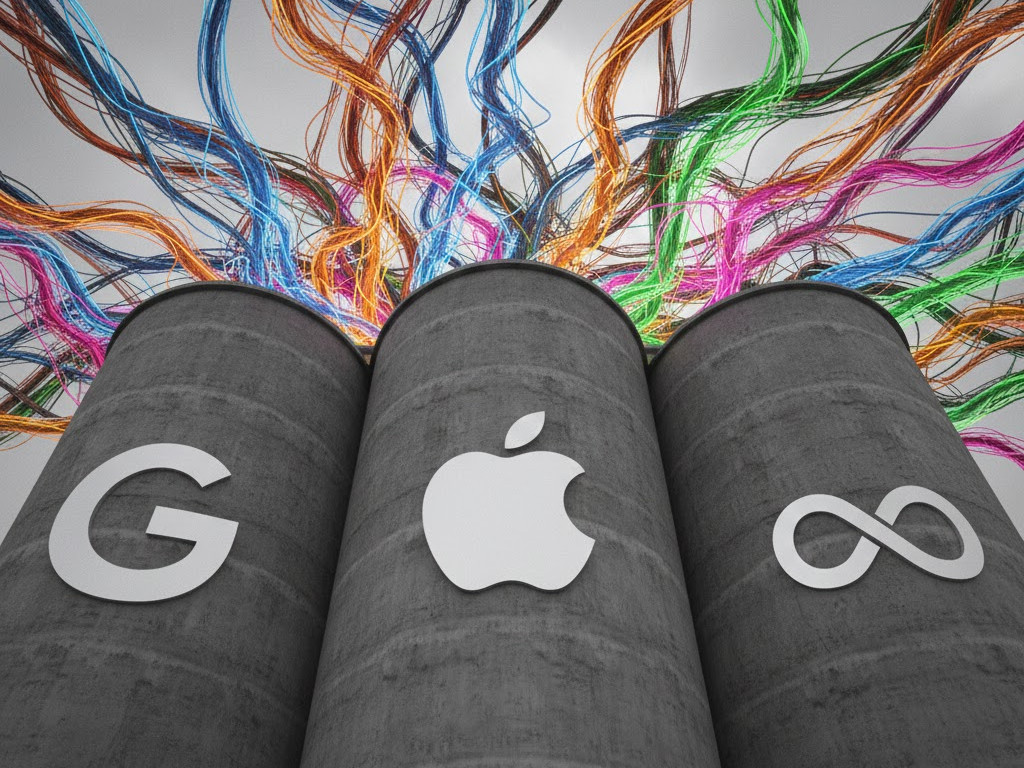
Facebook, WhatsApp, Instagram, Threads, Messenger. Five names, one company, one man, and three billion users who don't get a say. And that's just Meta. Add Google (Search, Gmail, YouTube, Maps, Android, Chrome, the Play Store), Amazon (AWS, where half the web runs without anyone realising), Apple (iMessage, the gilded garden you never leave), Microsoft (LinkedIn, GitHub, Teams, Outlook). They call it the "social" web. I call it an oligopoly. And oligopolies are for enriching oligarchs, not for connecting people.
Oh, and before anyone slaps a label on me: I'm left-wing, because I want citizens' data to be protected and public services not to depend on some Californian billionaire. No wait, I'm right-wing, because I want Europe to be sovereign and to stop being fleeced by foreign corporations. No, actually, I'm a communist, because I think communication protocols should belong to everyone. Then again, libertarian, because I want anyone to be able to host their own server without asking permission. Or maybe green, because a 200 KB site uses less energy than a 14 MB React monstrosity. Actually no: I'm an engineer. I couldn't give a flying fig about the political compass. "Everything is political." Wonderful. Go tell that to a TCP packet, it'll cope. Here we're talking about protocols, architecture, and who controls your data. The rest is for the op-ed writers.
The problem isn't the technology
Let's start by being honest: Facebook works. WhatsApp works. Google works. Technically, they're even rather well made. Sending a message to the other side of the world in one second, for free, is an engineering marvel. The problem was never the technology.
The problem is that to send a message to your grandmother, you have to go through a Californian company that reads the message (yes, even end-to-end encrypted, there are still the metadata: to whom, when, how often, from where), stores it on its servers, monetises it through targeted advertising, and reserves the right to close your account if it doesn't like your face. Or if the algorithm decides your holiday photo violates the terms of service. (cough)
You are not the customer. You are the product. We've known this since 2010, and yet we're still there. Because "everyone's on it". The most effective circular argument in the history of capitalism.
We handed the web to advertisers
Take a second and think: who are the most powerful companies on the web? Google: an advertising agency. Meta: an advertising agency. Amazon: a shopping centre with an advertising agency. These aren't technology companies. They're advertising companies that use technology as a vehicle. We handed the keys to the global network of human knowledge to billboard salesmen. Ad vultures in Silicon Valley hoodies.
And it shows everywhere. You open a news site in 2026: cookie banner, newsletter popup, autoplay video, interstitial ad, trackers from a dozen different ad networks, and somewhere in the middle, if you're lucky, three paragraphs of actual content. The whole thing weighs 8 MB and takes fifteen seconds to load. For text. We went from the hypertext document to the interactive advertising application. Tim Berners-Lee must be weeping in a corner.
And how did we get here? Because the business model of the "free" web is advertising. And advertising demands targeting. And targeting demands data. And data demands tracking. And tracking demands JavaScript. Lots and lots of JavaScript.
Websites that aren't websites any more
Open YouTube. Inspect the source. That's not a website. It's a JavaScript application running in your browser that happens to display videos between ads. Open Gmail. Same thing. Google Maps. Same thing. LinkedIn. Same thing. "Web applications" weighing several megabytes of compiled, minified, obfuscated JS, turning your browser into a virtual machine running software nobody asked for.
And it's become the norm. JS frameworks push developers to build "Single Page Applications" for everything. A blog? SPA. A brochure site? SPA. A recipe page? SPA with React, Webpack, a state manager and three layers of abstraction. (sounds of keys being hammered in anger)
The result: 15 MB sites that take ten seconds to display text, that break the browser's back button, that don't work without JavaScript, that are unreadable for screen readers, and that consume as much RAM as a video game. To display words.
The web was a document system. HTML was made for that. Documents linked together, readable by anyone, on anything. And we turned it into an execution platform for advertising applications. We took the most democratic thing ever invented and turned it into a shopping centre.
Centralised: one king, one castle
The centralised model is simple: one server, one company, one boss. You want to communicate? You go through them. You want to leave? You lose everything: your contacts, your messages, your photos, your history. Ten years of your digital life, locked in a proprietary format that nobody else can read.
And they all do it.
Meta is the most obvious. A "social" network where you can't talk to someone on Twitter. A messaging service (WhatsApp) that can't send a message to Signal. A photo network (Instagram) that can't display photos from Flickr. Five apps, one silo, three billion voluntary prisoners.
Google is the most insidious. Because Google isn't a service, it's an ecosystem. You search on Google, read your email on Gmail, watch videos on YouTube, browse with Chrome, navigate with Maps, your phone runs Android, your files are on Drive, your photos on Google Photos, your diary on Google Calendar. And all that data converges in the same place: the largest advertising agency in the history of humanity. Google knows where you are, what you're searching for, who you're writing to, what you're watching, where you're going and what time you wake up. But it's free, so everything's fine. (nervous laughter)
Amazon is the most invisible. You think you don't use Amazon because you don't shop on amazon.co.uk? Sorry. AWS hosts a third of the web. Netflix, Airbnb, Slack, parts of the French government. All running on Amazon's servers. When AWS sneezes, half the internet catches a cold. We collectively decided that a single shop could also be the infrastructure of the global network. What could possibly go wrong?
Apple is the most elegant. The gilded garden. Everything is beautiful, everything is smooth, everything works. As long as you stay inside. iMessage only talks to iPhones (green bubbles, social contempt colour-coded). AirDrop only works between Apple devices. Your music is on Apple Music, your files on iCloud, your life in an ecosystem whose exit is carefully hidden behind immaculate design. The cage is golden, but it's still a cage.
Microsoft is the oldest. The most entrenched. Windows, Office, Teams, Outlook, LinkedIn, GitHub, Azure. They don't even need to be aggressive any more: they're everywhere through inertia. Your company uses Teams. Your school uses Office 365. Your CV is on LinkedIn. Your open-source projects are on GitHub. Yes, open source, hosted by Microsoft. The irony isn't lost on you. And with Azure, they're in direct competition with AWS to be the other invisible pillar of the web.
Imagine a world where Orange subscribers couldn't call Free subscribers. Absurd, right? That's exactly what all of these companies do with your messages, your photos, your files and your data. But nobody is outraged because they put likes, stories and dog filters on top.
Decentralised: no king, no castle, no rules
At the other end of the spectrum, there's "decentralised". The crypto-libertarian fantasy. No central server, no authority, no moderation, no one in charge. Everyone is equal, everything is on the blockchain (or on a peer-to-peer network, or on IPFS, or on whatever's fashionable this week).
On paper, it's seductive. In practice, it's a nightmare. No authority = no moderation = a digital Wild West where spam, harassment and illegal content thrive undisturbed. No central server = dreadful performance. No one in charge = nobody to turn to when things break. And then there's the energy question, but that's another post (pointed look at Bitcoin).
Total decentralisation is anarchy in the pejorative sense. It doesn't scale, and it doesn't protect anyone.
Federated: kingdoms that talk to each other
And then there's federated. And this is where it gets interesting, because we all know federation. We use it every day. It's called email.
Email is federated. You have an account at Gmail, your neighbour is on Proton, your colleague runs their own server. And everyone can write to everyone. Nobody needs to be "on the same platform". There's no CEO of email deciding the rules. Each server has its own terms, its own moderation, its own technical choices. And if you don't like your provider any more, you leave, and you keep your address book.
That's exactly how the web was designed. Independent servers communicating with each other through open protocols. HTTP, SMTP, XMPP. The entire early web was federated. And it worked. And it still works, for email.
So why did we agree to go back to the Minitel?
(And for the record: I actually like the Minitel. I was too young to understand how it worked at the time, but the idea was brilliant: a simple terminal, a network of services, a text interface accessible to everyone. The problem with the Minitel was the bill. Mum and Dad remember that part very well. The 3615 at 1.27 francs a minute was capitalist exploitation set to the sound of dial-up beeps. We've reproduced exactly the same model with the centralised web, except instead of paying in francs we pay in personal data. At least the Minitel had the decency to show you the bill.)
Federation in practice
This isn't science fiction. It exists today, it works, and it's usable by real people (not just bearded blokes in Stallman t-shirts, even though I own the t-shirt):
- Mastodon and the Fediverse: like Twitter, but federated. Your account lives on an instance (a server), you talk to the whole Fediverse. If your instance shuts down, you migrate. The protocol is called ActivityPub, and it's a W3C standard, not a billionaire's toy.
- Matrix: like WhatsApp/Slack, but federated. Instant messaging, calls, rooms, end-to-end encryption. Your server, your rules, and you talk to all other Matrix servers. The French military uses it (under the name Tchap). It's not a gimmick.
- PeerTube: like YouTube, but federated. Host your videos on your instance, they're visible across the entire network.
- Pixelfed: like Instagram, but federated. Photos, filters, likes, and not a single algorithm deciding what you should see.
And the best part: all of these talk to each other through ActivityPub. A Mastodon account can follow a Pixelfed account. A PeerTube video can be commented on from Mastodon. It's a network of networks. Funny, that reminds me of the original name of something that worked out rather well...
"But nobody's on it"
I can hear it from here. And yes, it's true: your colleagues are on WhatsApp, your family on Facebook, your friends on Instagram. The network is the network effect.
But think about it: at one point, nobody was on Facebook either. We were on forums, blogs, mailing lists, personal websites. Spaces we owned. And then we gave it all up for convenience, for "everyone's on it", for the algorithmic feed that does the work of choosing what we read.
We can go back. Not overnight, not by forcing people, but by showing that the alternative exists, that it works, and that it respects what the centralised web has forgotten: that your data belongs to you, that your online identity shouldn't depend on a company's goodwill, and that communicating with someone shouldn't require signing up to the same service.
The web was invented to be federated. It's time to remember that.