
Thank you, Mr Trump
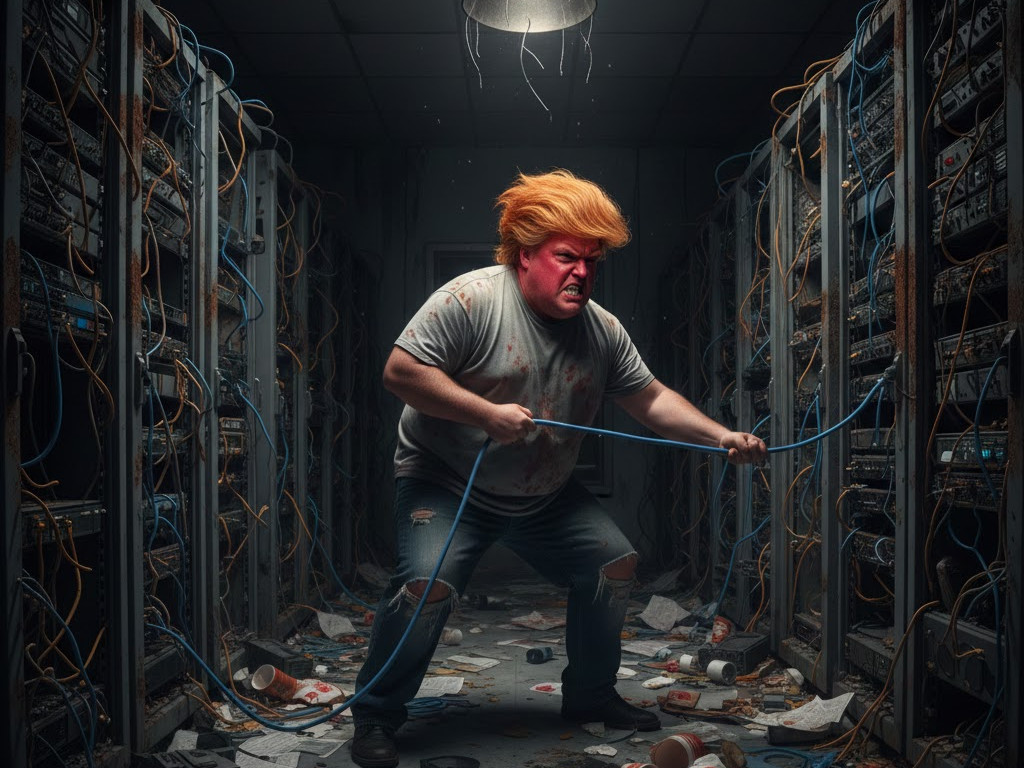
Let's start with something I never thought I'd write: thank you, Donald.
Let me be clear: I reckon Trump has less judgement than a six-month-old baby. He's not even the real problem. The real problem is the people around him. His advisors are worse, by a long stretch. The difference is that Trump is a loud idiot. He talks, and talks, and talks, and by talking so much he ends up leaking state secrets in front of the cameras. His advisors produce the same catastrophes without making a sound. (still waters run deep)
So why "thank you"? Because by hastily signing a few executive orders, he exposed what everyone was pretending not to see: the whole of Europe depends on American digital infrastructure. Our data, our services, our tools, all hosted on the other side of the Atlantic. And when the man holding the servers unilaterally decides your rules no longer count, the scale of the problem suddenly hits home.
Disclaimer: politics doesn't interest me. "Everything is political," yes, very charming at dinner parties, deeply irritating in practice. I'm not left, not right, not centre, not anything else. I'm an engineer. International alliances, power struggles between nations, speeches about the world order, that's not my field and I'm not going to pretend otherwise. There's only one subject that interests me here: IT sovereignty. The pipes, the servers, the data, the code. That, I know.
The rude awakening
When an American president can, with a stroke of a pen, threaten to cut access to services that European governments, hospitals, schools and businesses depend on, there's a problem. And the problem isn't Trump. It's that we let this happen.
Your emails are on Gmail. Your documents are on Google Drive or Microsoft 365. Your health data passes through AWS servers. Your source code is on GitHub (Microsoft). Your conversations are on WhatsApp (Meta). Your meetings are on Teams (Microsoft) or Zoom (also American, surprise). Your entire digital life (personal, professional, administrative) is hosted in a country whose leader can decide, on a Tuesday morning, that European data protection laws are "unfair to American businesses". (cough Cloud Act cough)
Trump didn't create this dependency. He simply made it impossible to ignore.
The French government, or the art of lecturing in holey socks
Because let's talk about France. Our beautiful country that loves giving speeches about digital sovereignty and which, in practice... (deep breath)
Health Insurance. Your health data, the most sensitive there is, passing through infrastructure hosted in the United States. Your reimbursements, your conditions, your prescriptions, all on servers subject to American law. The GDPR? It protects your data as long as the server is in Europe. When it's in Ashburn, Virginia, the Cloud Act applies. And the Cloud Act, in short, is: "If we want your data, we take it." But sleep tight, they sent you a privacy notice in PDF.
Passwords. Ah, passwords. Remember the France Travail data breach? The CAF breach? The hospital breaches? Every time, the same festival: passwords in plain text, systems not updated, contractors with admin access using "123456" as their password. "123elysee" is not a good password. "Marianne2024!" isn't either. And "MotDePasse" even less, though I'm sure someone is using it right now in a ministry. (shudder)
Public procurement. The French state signs contracts with Microsoft to equip national schools. With Google to host research data. With Amazon for cloud services. Every time, they explain there's "no credible alternative". No alternative? Seriously? There are alternatives. They're French, European, open source, auditable, sovereign. But they require effort, political will, and a budget. And apparently it's easier to write a cheque to Redmond.
De-Googlify yourself
I use "de-Googlify" but it's broader than Google. It's freeing yourself from all the GAFAM. And no, it's not just for bearded types (though I do own the Stallman t-shirt, I've said it). It's a choice anyone can make, gradually, without throwing their phone out the window on a Monday morning.
A few concrete, tested options that work:
- Search engine: Qwant (French), DuckDuckGo (American but doesn't track you), or SearXNG (self-hostable, federated, well well).
- Email: Proton Mail (Swiss, encrypted), or your own server if you're motivated.
- Cloud and files: Nextcloud, the replacement for Google Drive/Dropbox/Calendar/Contacts in a single piece of free software. Hostable at home or with a European provider.
- Instant messaging: Signal to start (it's the easiest), Matrix/Element to go further (federated, self-hostable).
- Browser: Firefox. Not Chromium, not Brave (Chromium-based), not Edge (also Chromium). Firefox. The last independent browser. Support it, otherwise Google will have a monopoly on the web. Oh wait, that's already nearly the case.
- Operating system: Linux. Yes, I know, it sounds scary. No, it's no longer just for tech people. Ubuntu, Fedora, Linux Mint, installs in twenty minutes and does everything Windows does, without sending your data to Microsoft every five minutes.
The state must lead by example
This isn't just a personal matter. Digital sovereignty starts with the state. And the French state has the means to act. It chooses not to.
The national gendarmerie has been on Linux (GendBuntu) since 2008. It works. It costs less. It's auditable. Why is the rest of the civil service still on Windows with an Office 365 licence hosted by Microsoft? Why does national education use Google Workspace instead of deploying Nextcloud instances? Why do hospitals entrust patient data to hosts subject to American law?
The answer is always the same: convenience, habit, lobbying, and lack of political will. It's not a technical problem. It's a problem of courage.
Free software, at last
Everything I've listed above (Linux, Firefox, Nextcloud, Matrix, Signal, Mastodon, PeerTube) has one thing in common: it's free software. The code is open, auditable, modifiable. Nobody can lock you in. Nobody can cut off your access. Nobody can change the rules on a Tuesday morning because a president signed a decree.
Free software isn't a niche gadget. It's the foundation of almost everything that works in modern computing. Linux runs 96% of web servers, the majority of smartphones (Android is Linux-based), all of the top 500 supercomputers worldwide. Free software is everywhere, except on your desktop, because you've been convinced you can't do without Word and Excel. (pointed look)
Free software is sovereignty. Not sovereignty in a minister's wooden-tongued speech, but the real kind: where you control your tools, your data, and your digital destiny. Where an angry tweet from a foreign president can't switch off your infrastructure.
So thank you, Mr Trump. Thanks to you, perhaps we'll finally wake up.
(But I doubt it.)